TeachMeet

I was recently looking at a variety of education blogs over the Easter break and I came upon a very interesting blog by Ewan McIntosh. Ewan is one of Europe’s foremost experts in digital media for public services, particularly in education. He is an enthusiastic educator with a passion for learning and development who wants to bring education into the 21st century.

He was a key player in setting up one of the most ambitious investment funds from a public service broadcaster in the UK (Channel4), himself making the call on investing over £1m in cutting edge and high impact digital media products. He is also the founder of 38minutes.co.uk, the creative industries platform for the North of the UK. His understanding and application of the latest web, mobile and games technology also continues to influence policy and practice in the world of education, where his personal passions lie.

Ewan founded TeachMeet in 2006 as a means of gathering enthusiastic but often unheard educators under one, beer-filled roof, to share the innovations going on in their classrooms. Senior education officials were always invited along to listen. No keynotes. No spotlight sessions. One teacher to another. Key to its success was gaining support from the education and publishing industry to sponsor drinks, food and a/v for a community that has gone from six educators to several thousand, going from Scotland to a worldwide phenomenon. Personally, I haven’t attended a TeachMeet event as yet (sorry!) but I would love to go to one soon. Talking and listening to other educators is a great way to develop yourself as a teacher and to improve your lessons and school. I have read a lot about TeachMeet in the past and I think it is time one came down to my area of the world! Anyone fancy organising a TeachMeet event down in Dorset?

Assessing Your Subject Area

This week myself and the geography department have been looking at how effective we are as teachers, as a department and ways of moving forward. This is not always easy to do but a very important part of our role as teachers. It is vital that as practitioners we are reflective and build upon our strengths and areas for development. Every teacher is different and all add something to a school.

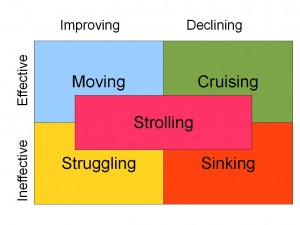
This week we have used Stoll and Fink’s analysis upon our department. It was originally used as a tool to look at whole school development but many practitioners are using it for subject areas.

Using the diagram above and the explanations below you have to try to judge your department/school on where you think you are. We tried to look at individual key stages as well.

Moving

  • Boosts student progress and achievement.
  • People work together and respond to change.
  • People know where they are going and have the will and the skill to get there.

Cruising Subject Area

  • Appear to have many of the qualities of an effective subject area.
  • Pupils achieve despite the teaching.
  • The people are responding well to change.

Strolling Subject Area

  • Neither particularly effective or ineffective.
  • Move at an adequate pace to cope with change.
  • Have ill-defined aims.
  • Conflict sometimes inhibits progress.

Struggling Subject Area

  • Ineffective and know it.
  • Expend energy trying to improve but results in “thrashing about”
  • They are willing to try anything and will ultimately succeed.

Sinking Subject Area

  • Staff are isolated.
  • There is an unwillingness to change either through ignorance or apathy.
  • There is a blame culture.
  • Student achievement is poor and failing.

It is not an easy task and you have to be very honest as a department. It is an ideal tool especially with self-evaluation high on the list of things Ofsted look at. It also gives you and your department to start thinking about what areas you might need to develop over the coming months or year. As a Head of Department it has made me realise where we need to go as a department and what our priorities are for the year ahead.

comicbrush: A Tool for the Classroom

Comic Brush is an online comic maker that I have recently found and used. Comic Brush is a very versatile and easy tool to use and seems well suited to the classroom. Rather than drawing a comic from scratch, Comic Brush lets you mix stock artwork from their fun collection of comic backgrounds, characters and props with photos of your friends, neighbourhood or school.You can add speech balloons, text, your own artwork and more, before printing or publishing your comic to the Web, social networking sites like Flickr, Facebook and MySpace, or a friend’s iPhone/Touch.

I have used Comic Brush for my Year 7 Settlement assessment on shanty towns. I have used the tool as a way of getting the pupils to start thinking about the push/pull factors involved in migration within developing countries. It is a different way of getting information put across to pupils or for them to present their work. For those who find literacy difficult or are visual learners, this is an ideal tool. It could be very useful as a data presentation method for controlled assessments using images the students had taken on their fieldtrip and explaining their findings. My first adventure into Comic Brush is below, enjoy!

Plymouth University e-Learning Conference 8-9th April

My old university is holding it’s 5th e-Learning Conference. This year they will examine the theme of e-learning in a time of change, and will challenge notions of traditional boundaries, learning spaces and roles. The conference will focus on new practices, new technologies, new environments and new learning. The conference is taking place on Thursday 8th and friday 9th April.

The Plymouth e-Learning Conference is jointly organised by the Faculty of Education and EDaLT (Educational Development and Learning Technologies) at the University of Plymouth.

At the conference two keynote speakers will be attending; Josie Fraser and Donald Clark. Josie Fraser is well known in the field of social media and learning, and writes regularly about her research on her blog SocialTech. Josie spreads her time and energy across a wide variety of social media/networking spaces, where she can be found experimenting with all manner of emerging technologies. At the ALT-C 2008 Conference, she received the prestigious Learning Technologist of the Year award and continues to be at the forefront of learning technology development.

Donald Clark was CEO and one of the original founders of Epic Group plc, which established itself as the leading company in the UK e-learning market. He is now a board member of Ufi (LearnDirect), LINE Communications, Caspian Learning, Brighton Festival, and a school governor. He has produced over 40 papers, dozens of book reviews and many articles on e-learning. Donald has also won many awards for the design and implementation of e-learning, notably the ‘Outstanding Achievement in e-learning Award’.

It looks like a cracking conference and I look forward to hearing the thoughts and feelings that come out of it.

Personal, Learning & Thinking Skills

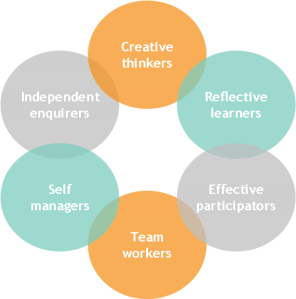
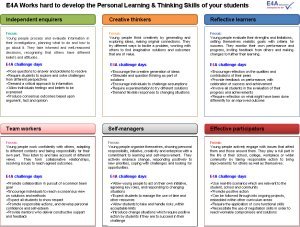
I am slowly catching up with my blogs at the moment as it seems to be a very busy term so far. Recently I went on a course run by Dorset County Council. This was my first course in my new county having previously worked in Hampshire and Surrey. The course itself was based on ‘Focusing on Skills in Foundation Subjects’ particularly personal, learning and thinking skills and run by Katie Ashcroft, Foundation Subjects Consultant. Personal learning and thinking skills (PLTS), together with functional English, mathematics, and ICT, cover the areas of competence that are most often demanded by employers. Integrating these skills into the curriculum and qualifications will provide learners with a platform for employability and further learning. PLTS involve:

  • team working
  • independent enquiry
  • self-management
  • reflective learning
  • effective participation
  • creative thinking.

The course itself was split into three sessions;

  • Session 1 – Developing pupils’ independent enquiry skills
  • Session 2 – Developing pupils’ team work skills
  • Session 3 – Developing a cross-curricular approach in foundation subjects

It is was a very informative and enjoyable course. It was great that they re-emphasised the importance of PLTS in lessons. PLTS help prepare pupils for the future, in and out of school. They develop the essential skills and qualities for to be a life long learner, life and future employment. They also provide a common focus for learning across subjects and provides great opportunities for cross curricular collaboration. PLTS use functional, transferable and creative skills which can be applied to real life scenarios.

It was pleasing to be given the opportunity during the course to identify the skills our department might want to develop in geography and reflect. With the new GCSEs and A’Level syallbus’ this course has come at a good time for reviewing the schemes of work we have developed so far and want to develop in the future. As teachers we sometimes forget about the skills the pupils require and focus on the content we need to teach. It has to be a balance of both and is something we feel at Gillingham we are achieving. It is also vitally very important that the pupils are clear about the skills they need to be successful in your subject area.

There was particular emphasis on cross curricular links and their importance within schools. This is a requirement within the new Secondary Curriculum for all subjects to explore connections with other subjects. Cross-curricular links provide a more coherent and relevant experience for the learner. It enables all pupils to understand the importance of different subjects and in helping them make a sense of the world. It provides pupils with the opportunity to apply the knowledge, understanding and skills they have acquired in one subject to a different context. For those of you investigating to develop cross-curricular links I recommend looking at the subject comparison web-page provided by the National Curriculum, which can be accessed here.  

The course linked the theory of skills to what Ofsted are looking for within schools. This is key for any school to have an awareness of what Ofsted expect from us as practitioners. I have quoted below Ofsted’s expectations;

‘The school’s curriculum provides memorable experiences and rich opportunities for high-quality learning…The school may be at the forefront of successful, innovative curriculum design in some areas…A curriculum with overall breath and balance provides pupils with their full entitlement and is customised to meet the changing needs of individuals and groups…Cross-curricular provision…is mainly outstanding and there is nothing less than good. As a result, all groups of pupils benefit from a highly coherent and relevant curriculum which promotes outstanding outcomes.’

These are skills I feel all schools’ are trying to achieve. Unfortunately, they do not happen over night and they do take time to develop and integrate in the school community. By sharing good practice, an understanding of what we want to achieve and hard work these skills will start to appear in all schools.

The Apple Revolution

Over the last twelve months I have read and reviewed the merits of the Apple iPhone. Yesterday, after several hours (!) of decision making I finally gave in and signed up. Already I have seen the benefits this could potentially bring to my teaching and the students learning.

Apple themselves state that ‘technology shapes the way students interact with the world. So it only makes sense to teach them with the tools and media they’re already using. Creating digital content is truly simple, web research is quick and secure, and virtual collaboration is safe for young learners.’

The applications that the iPhone can offer is changing daily with an ever increasing amount of choice. Many education blogs have been written about the positive and negative factors mobile phones can offer education. Ollie Bray, National Adviser for Learning and Technology Futures at Learning and Teaching Scotland (LTS), has been backing the use of mobile technology for some time in Scotland and has written several blogs and articles on this very subject. Back in January Dave Rogers, Curriculum Leader for Geography at the Priory School in Portsmouth, wrote a great blog about all the features the iPhone offers education. He clearly explains each app and its merits in teaching.

I Education Apps Review (IEAR) is a dedicated website for educational bloggers who contribute reviews of current educational apps available in the iTunes store. This is a great way to find out which apps are available for your subject area and what works for you.

The technology available to us as teachers is immense and is changing at a rate faster than we are able to keep up with. Students and pupils are far and away ahead of us as teachers when it comes to technology. As a teacher we are forever changing our teaching methods and resources. Mobile phones could help enrich a subject and make it more widely available for all students to participate. They have so much potential for the classroom. Mobile phones will enhance a pupils/students learning. They will give students skills that they will use in the wider world. They will bring benefits that will develop our own teaching. I am very much looking forward to working with my new piece of technology and improving my teaching.

Rockin’ All Over the World

In my lessons I always plan to include a variety of activities, different learning approaches and trialling out new ideas to help the students’ understanding and enjoyment of the subject. Music can entice a young person’s mind and start to make them think. Thinking skills are vital in education. Young people need to develop their thinking skills. Music works on many levels and can attract many different types of learners. It can spark their interest or reinforce their learning and make them more inquisitive. Music appeals to the auditory learner. Sections, lines or quotes could all be used to help a young person gain an understanding of a story, case study or theory. It is also a great cross-curricular way of working with another department. For example, your music department might be teaching South American music whilst in geography you teach Brazil. Simple, but effective!

I remember one of my geography teachers playing Dire Straits’ ‘Telegraph Road’ to us to help us with settlement change. As a guitarist I love Dire Straits and was immediately hooked by the lesson. My geography teacher at the time, Mr. Leach, started to explain the song lyrics. We listened again and wrote down what we heard and applied it to our topic we were studying – settlement.  He had used it as a lesson starter on settlement change. This was my first introduction into the use of music within geography. Thank you Mr Leach!

What would be your top ten music starters be? 

My Top Ten Geography Music Starters

  • Telegraph Road – Dire Straits (Settlement)
  • Paradise City – Gun ‘N’ Roses (City Change)
  • Why does it always rain on me – Travis (Weather)
  • Ring of Fire – Johnny Cash (Plate-tectonics)
  • Rocks – Primal Scream (Geology)
  • The Sea – Morcheeba (Coasts)
  • Starsky & Hutch Theme – The James Taylor Quartet (Crime)
  • Mas Que Nada – Tamba Trio (Brazil)
  • Magical Mystery Tour – The Beatles (General Geography)
  • The End of the World as we know it – REM (Climate Change)

Proud to be a teacher!

Q. What do the following people have in common; Mark Knopfler, Chris Tarrant, Sheryl Crow, Nick Hornby, Frank Skinner, Stuart Maconie, Jim Bowen, Alan Bleasdale, Ian Drury and Sting?

A. They have all worked as teachers. 

What is it that drives us to become teachers? I say ‘us’ as we are different…I don’t mean to offend anybody but there is a certain type of person who becomes a teacher. I love teaching…it is simple as that. It’s not just a job I go to Monday to Friday but a way of life. Teaching has given me the chance to inspire and encourage a young persons mind to love the art of learning. But it isn’t a role that everyone will enjoy. There are of course disadvantages to teaching, so why do it?

Teaching is a popular profession for many graduates. Last year 38,918 (TDA Training Profile 2008) people completed a PGCE. The number of graduates completing PGCE’s has steadily risen over the last few years. It is a role that people find exciting, challenging and extremely stimulating. It is a profession where we are able to move people forward in their aspirations and assist their learning. Friends will know that I sometimes refer teaching to stand-up comedy. You have thirty pupils sitting in front of you expecting to learn. It is up to us to take it upon ourselves and show our worth. We need to work collectively together to make education great. We sometimes get too much bad press and the papers gloss over the successes and achievements that teaching has bought to so many thousands of pupils and students. We must praise each other in this very sacred profession.

Nicholas Hargreaves of Radipole School, Weymouth backs this up by saying, ‘Teaching is a wonderful career choice for anyone. From a young age several teachers and friends helped and encouraged me to aspire to become a teacher. To provide young minds with the knowledge, skills and passion to take control of their lives and become the experts of tomorrow. Personally it has given me the chance to inspire young people with my knowledge and expertise. Working with a group of like minded teachers and young people is extremely inspirational. It is a role I have always been determined to succeed in and work hard for.’

The role teachers’ play in their local community is also central to a student’s development. Schools’ and communities must work collaboratively together for an area to benefit. Economic investment is a necessity with schools. Schools are the training ground for our future generations and they need to be at the forefront of technology for our young learners with the very best facilities for them to achieve their potential. The local community and schools’ must be incorporated into working together to create an ethos of self belief and to achieve their personal best. The community must be involved in their local schools creating community centres, so local people can benefit from the facilities and technology a school has. A community that sees the benefit of an education can help generate our leaders of tomorrow but they must work in partnership with the local schools. We as teachers are the facilitators of this role and can help enrich a wide variety of lives in the process. Working with the local community to enhance the school ethos and help an area develop.

Teaching in my opinion is the greatest role in life that someone can do. To actually see the look of wonder and understanding on someone’s face is something that cannot be bought. To pass on knowledge and see where it takes a young person in life is amazing. To actually help young people in life choose a path in the life with your encouragement and guidance is breathtaking.  

Russell Wait, of Cove School, Hampshire; ‘I was inspired by my secondary school Headteacher who encouraged me from the tender age of 12 to reach my aspirations and goals. I find that teaching is an ever changing occupation that keeps you on your toes. To teach the future generation of Britain with a passionate voice can create change and can only be a benefit for the country.’

Many professionals from industry are turning to a career in teaching because of the many benefits the role brings. They bring with them a vast range of experiences from industry that can only enhance the profession. Experience from outside the classroom and shared with the students is vital. Young people do need to have role models and even though they sometimes might not want to admit it, teachers are a very important one. Only recently the government announced the newly planned PGCE changes where graduates can complete the course in six months. It is very clear that many people want to train as teachers but cannot afford to take a whole year off for training. With the recent credit crisis it is understandable, but it does show that people do want to be teachers.

When former pupils come into my school and remember certain times, events or even lessons, I am proud. Proud to be a teacher, proud to have had a positive effect on somebody’s life, proud to have taken on this honoured to have helped a young person. We have a wide pool of teachers with much experience. Working together we have helped create a career choice for many young professionals. Even Paul McCartney was planning to become a teacher if his band ‘The Beatles’ didn’t make it. Teaching is the best profession and don’t let anybody tell you otherwise! As Batman once said, ‘it isn’t what you say that defines you but what you do’ (Batman Begins, 2005).
The Book is Dead, Long Live the Book

So it is finally here – the iPad. My initial thoughts were not that good to be honest, but with further research and looking at different points of view I am now starting to see its merits. Firstly, I don’t think it is the nail in the coffin for the traditional book. Most people are very used to this successful formula and will probably not change. But for education purposes it could be successful and make reading more widely available.

Apple has been very clever in the sense that they have announced partnerships with Penguin, Harper-Collins, Simon & Schuster, Macmillan, and the Hachette Book Group. This enables Apple to set up their own in-house iBooks store like the successful iTunes that is currently available for music. Many people do find this method of shopping very appealing (especially young people).

The text could be enhanced by audio and visuals with the option of linking to the internet. This could help with many disaffected learners in the classroom.

The UK price for an iPad have not been announced but speculation has been around £400-£700 depending on the Wi-Fi scheme chosen and model. This is not cheap and I wonder if discounts would apply to schools?

Would Steve Jobs be willing for my school to trial some out?

Learning from Films

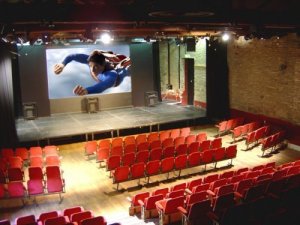
It was not long into my education career as a teacher that I started to realise the importance and usefulness of film in my lessons. I had always been using documentaries and footage from DVDs and videos in my lessons but I had not realised what films could offer. It got my mind racing on different aspects of films that could be shown to pupils within different subject areas. I soon realised that films could enhance and develop a pupils learning and encourage them to be life long learners.

In April 2009 I wrote an article for Sec-Ed regarding the usefulness of films in education called Learning from Films. I have used films in the classroom and have found they have a lasting impression on a young students mind. Films are a successful way of engaging and stimulating young people.

Films can enhance a lesson and excite a young mind with their powerful and thought provoking subject matter. Dr. Pietari Kaapa of the University of Nottingham has stated that, “cinema as both a popular form of entertainment and a means of artistic and political expression, is a crucial area of classroom teaching. The pedagogical potential of film provides an immediate and invigorating addition to established lesson plans, while the history of the medium and its contextual socio-cultural relevance function as sources of study in their own right.”

As a Geography Teacher I have used a wide variety of different films to help show and back up key terminology or sometimes complex geographical features. The world today has created a generation of young people with very active minds. The days of a teacher in a classroom talking for 50 minutes are long gone and would not generate much enthusiasm from today’s young learners. Interaction and variety is what is needed to engage learners and film is one medium that can grip a young person’s attention. Film can enthuse and generate much debate and help a learner.

Pupils are requested to use and take part in different types of media within their learning from the National Curriculum. Films like music should be encouraged to be used within the classroom. Nick Hargreaves of Radipole Primary School in Weymouth, Dorset, believes that ‘‘films are a really valid text as much as books. With the National Curriculum we have to look at various types of media within a child’s learning and film is one way. Films are not always easy to understand and it does take time sometimes for a young learner to fully understand the complexities of a film like the music changing in relation to the mood of the film.’’ As we are aware there are three types of learners; visual, auditory and kinaesthetic. A film is one medium that incorporates all three learning styles and can hold the attention and pass on knowledge and understanding to all three main learning styles.  Nick Hargreaves says ‘film takes into account how a learner learns…it attracts the three main types of learners and engages all of them in one sitting. It reaches out to all target levels especially boys’.

It is not only watching films but using/making films within a lesson. This is sometimes difficult to do with budgets and time constraints but can be a worthwhile exercise. Young people like to be more involved in classes and using digital film recorders is one way. Pupils should be encouraged to produce news reports, presentations or stop motion modelling to help their knowledge and understanding. The technology and resources are out there and we as teachers must start to use them for the benefit of our pupils and ourselves as practitioners.

It may be uncomfortable for some of us to film ourselves in a lesson and to watch our mannerisms but would it further develop ourselves as teachers? I think the answer would be yes and should be encouraged with any teacher new or old. Filiming ourselves could be way of encourging our own development as teachers.

I remember reading Great Expectations at school and found watching the David Lean adaption a much needed guiding hand when it came to revising for the GCSE. A film may not always be true or correct, but in the right hands, us as teachers, we can filter out the bad and use the great pieces of film there is out there waiting to be used.