Where now for geography?


After a very long and stressful journey to work today I was pleased to see one of my articles printed in Sec-Ed. Sec-Ed is the UK’s only free national teaching paper that is sent to every UK Headteacher and staffroom. I am a huge fan of the paper with its well written articles and comments on education and teaching in the UK. I have been very lucky in the past to have had several articles printed by them and I hope this continues for the future. Thank you to Pete Henshaw (Editor)  and Chris Parr (Chief Reporter) for all your help.

The article is titled  ‘Where now for geography?’ and focuses on geography’s fight for survival as a curriculum taught subject. This is quite a personal article being a geographer and I am very passionate about geography’s role within a schools curriculum. The article can be accessed here for your perusal. Enjoy!

TeachMeet

I was recently looking at a variety of education blogs over the Easter break and I came upon a very interesting blog by Ewan McIntosh. Ewan is one of Europe’s foremost experts in digital media for public services, particularly in education. He is an enthusiastic educator with a passion for learning and development who wants to bring education into the 21st century.

He was a key player in setting up one of the most ambitious investment funds from a public service broadcaster in the UK (Channel4), himself making the call on investing over £1m in cutting edge and high impact digital media products. He is also the founder of 38minutes.co.uk, the creative industries platform for the North of the UK. His understanding and application of the latest web, mobile and games technology also continues to influence policy and practice in the world of education, where his personal passions lie.

Ewan founded TeachMeet in 2006 as a means of gathering enthusiastic but often unheard educators under one, beer-filled roof, to share the innovations going on in their classrooms. Senior education officials were always invited along to listen. No keynotes. No spotlight sessions. One teacher to another. Key to its success was gaining support from the education and publishing industry to sponsor drinks, food and a/v for a community that has gone from six educators to several thousand, going from Scotland to a worldwide phenomenon. Personally, I haven’t attended a TeachMeet event as yet (sorry!) but I would love to go to one soon. Talking and listening to other educators is a great way to develop yourself as a teacher and to improve your lessons and school. I have read a lot about TeachMeet in the past and I think it is time one came down to my area of the world! Anyone fancy organising a TeachMeet event down in Dorset?

Assessing Your Subject Area

This week myself and the geography department have been looking at how effective we are as teachers, as a department and ways of moving forward. This is not always easy to do but a very important part of our role as teachers. It is vital that as practitioners we are reflective and build upon our strengths and areas for development. Every teacher is different and all add something to a school.

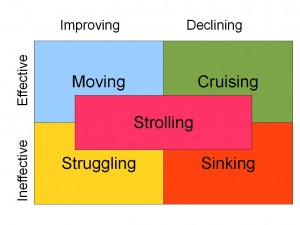
This week we have used Stoll and Fink’s analysis upon our department. It was originally used as a tool to look at whole school development but many practitioners are using it for subject areas.

Using the diagram above and the explanations below you have to try to judge your department/school on where you think you are. We tried to look at individual key stages as well.

Moving

  • Boosts student progress and achievement.
  • People work together and respond to change.
  • People know where they are going and have the will and the skill to get there.

Cruising Subject Area

  • Appear to have many of the qualities of an effective subject area.
  • Pupils achieve despite the teaching.
  • The people are responding well to change.

Strolling Subject Area

  • Neither particularly effective or ineffective.
  • Move at an adequate pace to cope with change.
  • Have ill-defined aims.
  • Conflict sometimes inhibits progress.

Struggling Subject Area

  • Ineffective and know it.
  • Expend energy trying to improve but results in “thrashing about”
  • They are willing to try anything and will ultimately succeed.

Sinking Subject Area

  • Staff are isolated.
  • There is an unwillingness to change either through ignorance or apathy.
  • There is a blame culture.
  • Student achievement is poor and failing.

It is not an easy task and you have to be very honest as a department. It is an ideal tool especially with self-evaluation high on the list of things Ofsted look at. It also gives you and your department to start thinking about what areas you might need to develop over the coming months or year. As a Head of Department it has made me realise where we need to go as a department and what our priorities are for the year ahead.

Raising Your Game – Improving Your Subject Area

Last week I attended a course run by ASCL Management and Professional Services in London. The course focused upon what subject leaders can do to improve the quality of teaching and learning in their subject area. It provided a coherent insight and practical approach to improving the performance of colleagues, which will help raise the pupils’ achievement in your department.

The aims and objectives of the day were:

  • to help improve learning and teaching in your subject area
  • to become familair with improvement strategies
  • to help integrate the improvment process
  • to understand ‘what effective teaching and learning looks like’
  • to develop skills to carry out effective lesson observations
  • to develop the skills of giving effective feedback and resolving conflict

The course was run by Geoff Barton, Headteacher at King Edward VI School in Suffolk and Peter Richards, a qualified SIP, teaching consultant and former Headteacher.

I found the course a great success and found both Geoff and Peter realists as professional teachers. They knew the rhetroric of being a successful subject leader and the reality. They were able to explain things very clearly and efficiently. The key question they kept referring to was; ‘Would you be happy for your child to be taught in the classroom?’. This was a brilliant way to question whether we were doing the right thing within our own subject areas.

It was clear by the end of the day that the five most important skills a great subject leader needs to develop were;

  • being visible,
  • optimistic,
  • working hard,
  • hungry for success
  • and resilient.

I could not argue with their thoughts and feeling throughout the day and found them brilliant speakers. It was an excellent course where I came away knowing more than before I went in. Both Geoff and Peter did try to link the course to Ofsted and what they were looking for as inspectors. For more information regarding the course please go to the ASCL website or Geoff Barton’s website.

The Apple Revolution

Over the last twelve months I have read and reviewed the merits of the Apple iPhone. Yesterday, after several hours (!) of decision making I finally gave in and signed up. Already I have seen the benefits this could potentially bring to my teaching and the students learning.

Apple themselves state that ‘technology shapes the way students interact with the world. So it only makes sense to teach them with the tools and media they’re already using. Creating digital content is truly simple, web research is quick and secure, and virtual collaboration is safe for young learners.’

The applications that the iPhone can offer is changing daily with an ever increasing amount of choice. Many education blogs have been written about the positive and negative factors mobile phones can offer education. Ollie Bray, National Adviser for Learning and Technology Futures at Learning and Teaching Scotland (LTS), has been backing the use of mobile technology for some time in Scotland and has written several blogs and articles on this very subject. Back in January Dave Rogers, Curriculum Leader for Geography at the Priory School in Portsmouth, wrote a great blog about all the features the iPhone offers education. He clearly explains each app and its merits in teaching.

I Education Apps Review (IEAR) is a dedicated website for educational bloggers who contribute reviews of current educational apps available in the iTunes store. This is a great way to find out which apps are available for your subject area and what works for you.

The technology available to us as teachers is immense and is changing at a rate faster than we are able to keep up with. Students and pupils are far and away ahead of us as teachers when it comes to technology. As a teacher we are forever changing our teaching methods and resources. Mobile phones could help enrich a subject and make it more widely available for all students to participate. They have so much potential for the classroom. Mobile phones will enhance a pupils/students learning. They will give students skills that they will use in the wider world. They will bring benefits that will develop our own teaching. I am very much looking forward to working with my new piece of technology and improving my teaching.

Phone’s For You!

The intrusive ringing and sounds of a mobile phone maybe the future of education. This is a very bold statement for a teacher to make. In the majority of schools mobile phones are banned, but that maybe changing across the country. Mobile phones are an untouched resource that could be more of a help then a hindrance.

The technology available to us as teachers is immense and is changing at a rate faster than we are able to keep up with. Students and pupils are far and away ahead of us as teachers when it comes to technology. As a teacher we are forever changing our teaching methods and resources. Mobile phones could help enrich a subject and make it more widely available for all students to participate.

This is not a new argument; The Daily Telegraph stated on 4th September 2008 that schoolchildren should be allowed to use mobile phones in the classroom to boost education standards. The Daily Telegraph was reporting about research conducted by Dr Elizabeth Hartnell-Young, from Nottingham University. She led a team into mobile phone research, and said: “While the eventual aim should be to lift blanket bans on phones we do not recommend immediate, whole-school change. Dr Elizabeth Hartnell-Young and her colleagues reached this conclusion after studying the consequences of allowing pupils in five secondary schools to use either their own mobile phones or the new generation of ‘smartphones’ in lessons.

“We believe that teachers, students and the wider community should work together to develop policies that will enable this powerful new learning tool to be used safely.

“We hope that, in future, mobile phone use will be as natural as using any other technology in school.”

Recently Dave Rogers wrote a great blog about all the features the iPhone offers education. Dave is the Geography Curriculum Leader at the Priory School in Portsmouth who is very enthusiastic about his subject. He clearly explains each app and its merits in teaching. For those of you who are interested in what mobile phones offer a teacher I thoroughly recommend looking at his blog.

Personally, I whole heartedly agree with this argument. They have so much potential for the classroom. Mobile phones will enhance a pupils/students learning. They will give students skills that they will use in the wider world. They will bring benefits that will deve lop our own teaching.
Mobile Learning…Ringing in the Classroom

I was particularly pleased to see that Google has released it’s Google phone last week. The market needs competition. Don’t get me wrong, I am a big fan of Apple’s iPhone and find their app’s superb. But as we are all aware technology is changing and improving all the time. Apple released their iPhone in June 2007. What can mobile phones offer as tools in the classroom? Are mobile phones the future of the classroom?

Personally I think the answer is yes. They have their merits as a tool within the classroom, but used in the correct mature manner. I openly invite a mobile phone company to let my department trial a set of phones to see their potential. Any offers?

Is the Google Android the new phone of the future?

Is it better than the iPhone?

Is the Google Android suited for schools?

Are iPhones the future for the classroom?

My Top Ten Geography Films

As I have previously stated in my blog and from my article for Sec-Ed, films are a fantastic way in which to engage young learners. For interest (and a bit of fun!) I have complied together my ‘Top Ten’ Geography related films. This first appeared in my article Learning from Films in April 2009 for Sec-Ed.

  • Slumdog Millionaire – life in within the shanty towns of Mumbai
  • Brassed Off – industrial decline in the UK
  • The Day After Tomorrow – climate change has never been this traumatic!
  • City of God – the daily lives of young people in the favelas of Rio
  • Twister – the formation and impact of a twister
  • There Will Be Blood – industrial growth of a more economically developed country
  • Dante’s Peak – shows most of the features of a volcano
  • Lawrence of Arabia – illustrates desert features
  • Kes – life in 1960s Britain
  • The Full Monty – industrial decline within the UK

Q. What would be in your Top Ten Films for your subject? I look forward to hearing from you.