Earth Hour – Get Involved


Today, Saturday 27 March 2010 at 8.30pm, the WWF want a billion people around the world to switch off their lights for one hour – WWF’s Earth Hour. The idea is to raise awareness regarding climate change that is affecting our planet. The first Earth Hour was in 2007 in Sydney, Australia where 2.2 million people took part. Since then it has gone global, 50 million people in 2008 and over a billion in 2009. In 2009, 4000 cities in 88 countries took part. The message is clear, climate change is not about the country you are from but the planet you live on.  

The WWF works to create solutions to the most serious environmental problems facing our planet, so that people and nature can thrive. Climate change is the biggest threat of all. Impacts such as changing weather patterns, warming seas and melting ice threaten to devastate people and nature, and to jeopardise all our conservation successes.To tackle the threat, it’s vital that world leaders agree effective international action. The WWF want urgent global action to safeguard the natural world. We’re already seeing the impacts of climate change – from melting Arctic sea ice to flooding and droughts.  

Tidd Tower will be turning its lights off at 8.30pm tonight. To get involved go to the WWF Earth Hour website here

Assessing Your Subject Area

This week myself and the geography department have been looking at how effective we are as teachers, as a department and ways of moving forward. This is not always easy to do but a very important part of our role as teachers. It is vital that as practitioners we are reflective and build upon our strengths and areas for development. Every teacher is different and all add something to a school.

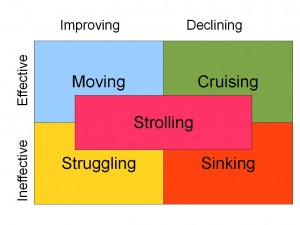
This week we have used Stoll and Fink’s analysis upon our department. It was originally used as a tool to look at whole school development but many practitioners are using it for subject areas.

Using the diagram above and the explanations below you have to try to judge your department/school on where you think you are. We tried to look at individual key stages as well.

Moving

  • Boosts student progress and achievement.
  • People work together and respond to change.
  • People know where they are going and have the will and the skill to get there.

Cruising Subject Area

  • Appear to have many of the qualities of an effective subject area.
  • Pupils achieve despite the teaching.
  • The people are responding well to change.

Strolling Subject Area

  • Neither particularly effective or ineffective.
  • Move at an adequate pace to cope with change.
  • Have ill-defined aims.
  • Conflict sometimes inhibits progress.

Struggling Subject Area

  • Ineffective and know it.
  • Expend energy trying to improve but results in “thrashing about”
  • They are willing to try anything and will ultimately succeed.

Sinking Subject Area

  • Staff are isolated.
  • There is an unwillingness to change either through ignorance or apathy.
  • There is a blame culture.
  • Student achievement is poor and failing.

It is not an easy task and you have to be very honest as a department. It is an ideal tool especially with self-evaluation high on the list of things Ofsted look at. It also gives you and your department to start thinking about what areas you might need to develop over the coming months or year. As a Head of Department it has made me realise where we need to go as a department and what our priorities are for the year ahead.

comicbrush: A Tool for the Classroom

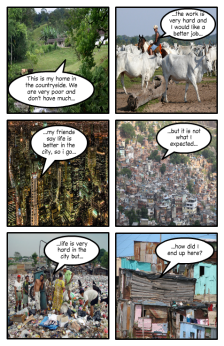
Comic Brush is an online comic maker that I have recently found and used. Comic Brush is a very versatile and easy tool to use and seems well suited to the classroom. Rather than drawing a comic from scratch, Comic Brush lets you mix stock artwork from their fun collection of comic backgrounds, characters and props with photos of your friends, neighbourhood or school.You can add speech balloons, text, your own artwork and more, before printing or publishing your comic to the Web, social networking sites like Flickr, Facebook and MySpace, or a friend’s iPhone/Touch.

I have used Comic Brush for my Year 7 Settlement assessment on shanty towns. I have used the tool as a way of getting the pupils to start thinking about the push/pull factors involved in migration within developing countries. It is a different way of getting information put across to pupils or for them to present their work. For those who find literacy difficult or are visual learners, this is an ideal tool. It could be very useful as a data presentation method for controlled assessments using images the students had taken on their fieldtrip and explaining their findings. My first adventure into Comic Brush is below, enjoy!

Raising Your Game – Improving Your Subject Area

Last week I attended a course run by ASCL Management and Professional Services in London. The course focused upon what subject leaders can do to improve the quality of teaching and learning in their subject area. It provided a coherent insight and practical approach to improving the performance of colleagues, which will help raise the pupils’ achievement in your department.

The aims and objectives of the day were:

  • to help improve learning and teaching in your subject area
  • to become familair with improvement strategies
  • to help integrate the improvment process
  • to understand ‘what effective teaching and learning looks like’
  • to develop skills to carry out effective lesson observations
  • to develop the skills of giving effective feedback and resolving conflict

The course was run by Geoff Barton, Headteacher at King Edward VI School in Suffolk and Peter Richards, a qualified SIP, teaching consultant and former Headteacher.

I found the course a great success and found both Geoff and Peter realists as professional teachers. They knew the rhetroric of being a successful subject leader and the reality. They were able to explain things very clearly and efficiently. The key question they kept referring to was; ‘Would you be happy for your child to be taught in the classroom?’. This was a brilliant way to question whether we were doing the right thing within our own subject areas.

It was clear by the end of the day that the five most important skills a great subject leader needs to develop were;

  • being visible,
  • optimistic,
  • working hard,
  • hungry for success
  • and resilient.

I could not argue with their thoughts and feeling throughout the day and found them brilliant speakers. It was an excellent course where I came away knowing more than before I went in. Both Geoff and Peter did try to link the course to Ofsted and what they were looking for as inspectors. For more information regarding the course please go to the ASCL website or Geoff Barton’s website.

From Slumdog to IT Surfer

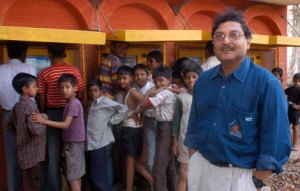
The Guardian newspaper yesterday wrote a brilliant article in its education supplement about Professor Sugata Mitra. It was a follow-up on to an article written last year on Mitra’s Hole In The Wall learning project. The project itself was about installing computers with internet connection in Delhi slums for local children to discover. The project discovered that the children began to teach themselves English, computing and maths. This was all in a month after installing the computers. It was from this that inspired Vikus Swarup to write Q&A, the book that became the film Slumdog Millionaire.

The project was a success and over five hundred computers can be found in walls across India and Africa. Mitra is now a professor at Newcastle University and is working on a new project in the UK, where is helping youngsters use computers to carry out ‘self-activated learning’ in the classroom.

According to Mitra, ‘having watched hundreds of Indian children learning without teachers at the Hole In The Wall computers…children can work by themselves, if they want to.’

‘Most British children grow up with the internet and the means to learn what they want in minutes, and this challenges the traditional idea of school being about learning things that will come in handy in the future. They become disengaged.’

‘If you encourage individual learning, and give children interesting questions to look independently, the learning process is sparked by curiosity.’

Mitra is currently working with some schools in Tyneside where is challenging primary school children with GCSE questions. The children are able to choose which question they would like to research and they are able to use computers freely within the room. The results are very impressive according to the teachers at the schools concerned. Three months after the project the pupil’s knowledge and learning had improved from the tests given. 

It is a very interesting and thought-provoking article and I recommend all teachers to read it. The link to the article can be found hereMitra has plans to develop autonomous learning within all schools. It is a fantastic project that could improve a pupils’ learning and knowledge and possibly make learning fun for all! Perhaps the developed world can learn new ways of teaching from developing countries. As Henry Ford once said, ‘all of us are smarter than one of us’.

Plymouth University e-Learning Conference 8-9th April

My old university is holding it’s 5th e-Learning Conference. This year they will examine the theme of e-learning in a time of change, and will challenge notions of traditional boundaries, learning spaces and roles. The conference will focus on new practices, new technologies, new environments and new learning. The conference is taking place on Thursday 8th and friday 9th April.

The Plymouth e-Learning Conference is jointly organised by the Faculty of Education and EDaLT (Educational Development and Learning Technologies) at the University of Plymouth.

At the conference two keynote speakers will be attending; Josie Fraser and Donald Clark. Josie Fraser is well known in the field of social media and learning, and writes regularly about her research on her blog SocialTech. Josie spreads her time and energy across a wide variety of social media/networking spaces, where she can be found experimenting with all manner of emerging technologies. At the ALT-C 2008 Conference, she received the prestigious Learning Technologist of the Year award and continues to be at the forefront of learning technology development.

Donald Clark was CEO and one of the original founders of Epic Group plc, which established itself as the leading company in the UK e-learning market. He is now a board member of Ufi (LearnDirect), LINE Communications, Caspian Learning, Brighton Festival, and a school governor. He has produced over 40 papers, dozens of book reviews and many articles on e-learning. Donald has also won many awards for the design and implementation of e-learning, notably the ‘Outstanding Achievement in e-learning Award’.

It looks like a cracking conference and I look forward to hearing the thoughts and feelings that come out of it.

Personal, Learning & Thinking Skills

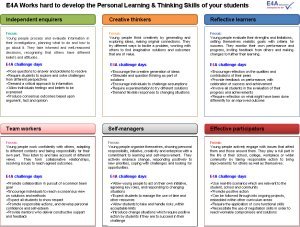
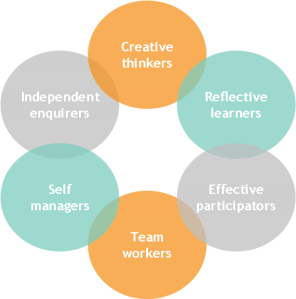
I am slowly catching up with my blogs at the moment as it seems to be a very busy term so far. Recently I went on a course run by Dorset County Council. This was my first course in my new county having previously worked in Hampshire and Surrey. The course itself was based on ‘Focusing on Skills in Foundation Subjects’ particularly personal, learning and thinking skills and run by Katie Ashcroft, Foundation Subjects Consultant. Personal learning and thinking skills (PLTS), together with functional English, mathematics, and ICT, cover the areas of competence that are most often demanded by employers. Integrating these skills into the curriculum and qualifications will provide learners with a platform for employability and further learning. PLTS involve:

  • team working
  • independent enquiry
  • self-management
  • reflective learning
  • effective participation
  • creative thinking.

The course itself was split into three sessions;

  • Session 1 – Developing pupils’ independent enquiry skills
  • Session 2 – Developing pupils’ team work skills
  • Session 3 – Developing a cross-curricular approach in foundation subjects

It is was a very informative and enjoyable course. It was great that they re-emphasised the importance of PLTS in lessons. PLTS help prepare pupils for the future, in and out of school. They develop the essential skills and qualities for to be a life long learner, life and future employment. They also provide a common focus for learning across subjects and provides great opportunities for cross curricular collaboration. PLTS use functional, transferable and creative skills which can be applied to real life scenarios.

It was pleasing to be given the opportunity during the course to identify the skills our department might want to develop in geography and reflect. With the new GCSEs and A’Level syallbus’ this course has come at a good time for reviewing the schemes of work we have developed so far and want to develop in the future. As teachers we sometimes forget about the skills the pupils require and focus on the content we need to teach. It has to be a balance of both and is something we feel at Gillingham we are achieving. It is also vitally very important that the pupils are clear about the skills they need to be successful in your subject area.

There was particular emphasis on cross curricular links and their importance within schools. This is a requirement within the new Secondary Curriculum for all subjects to explore connections with other subjects. Cross-curricular links provide a more coherent and relevant experience for the learner. It enables all pupils to understand the importance of different subjects and in helping them make a sense of the world. It provides pupils with the opportunity to apply the knowledge, understanding and skills they have acquired in one subject to a different context. For those of you investigating to develop cross-curricular links I recommend looking at the subject comparison web-page provided by the National Curriculum, which can be accessed here.  

The course linked the theory of skills to what Ofsted are looking for within schools. This is key for any school to have an awareness of what Ofsted expect from us as practitioners. I have quoted below Ofsted’s expectations;

‘The school’s curriculum provides memorable experiences and rich opportunities for high-quality learning…The school may be at the forefront of successful, innovative curriculum design in some areas…A curriculum with overall breath and balance provides pupils with their full entitlement and is customised to meet the changing needs of individuals and groups…Cross-curricular provision…is mainly outstanding and there is nothing less than good. As a result, all groups of pupils benefit from a highly coherent and relevant curriculum which promotes outstanding outcomes.’

These are skills I feel all schools’ are trying to achieve. Unfortunately, they do not happen over night and they do take time to develop and integrate in the school community. By sharing good practice, an understanding of what we want to achieve and hard work these skills will start to appear in all schools.
The Apple Revolution

Over the last twelve months I have read and reviewed the merits of the Apple iPhone. Yesterday, after several hours (!) of decision making I finally gave in and signed up. Already I have seen the benefits this could potentially bring to my teaching and the students learning.

Apple themselves state that ‘technology shapes the way students interact with the world. So it only makes sense to teach them with the tools and media they’re already using. Creating digital content is truly simple, web research is quick and secure, and virtual collaboration is safe for young learners.’

The applications that the iPhone can offer is changing daily with an ever increasing amount of choice. Many education blogs have been written about the positive and negative factors mobile phones can offer education. Ollie Bray, National Adviser for Learning and Technology Futures at Learning and Teaching Scotland (LTS), has been backing the use of mobile technology for some time in Scotland and has written several blogs and articles on this very subject. Back in January Dave Rogers, Curriculum Leader for Geography at the Priory School in Portsmouth, wrote a great blog about all the features the iPhone offers education. He clearly explains each app and its merits in teaching.

I Education Apps Review (IEAR) is a dedicated website for educational bloggers who contribute reviews of current educational apps available in the iTunes store. This is a great way to find out which apps are available for your subject area and what works for you.

The technology available to us as teachers is immense and is changing at a rate faster than we are able to keep up with. Students and pupils are far and away ahead of us as teachers when it comes to technology. As a teacher we are forever changing our teaching methods and resources. Mobile phones could help enrich a subject and make it more widely available for all students to participate. They have so much potential for the classroom. Mobile phones will enhance a pupils/students learning. They will give students skills that they will use in the wider world. They will bring benefits that will develop our own teaching. I am very much looking forward to working with my new piece of technology and improving my teaching.

Severn Bore Wonder!

I love geography! No matter what happens in the world human nature and the environment itself continue to amaze me. A once-in-a-decade tidal wave surged down the River Severn this morning carrying a horde of surfers relishing the rare natural phenomenon. Hundreds of people from all over the country have lined the river bank to witness the spectacle. The huge wave, caused by the incoming tide being funnelled up the narrowing Severn Estuary, was expected to reach more than 5.4 metres (17.7ft) high. Scores of surfers tried to ride the five-star bore as it headed upstream earlier.

The Severn Estuary experiences the second highest tide anywhere in the world and the bore’s average speed is 10 mph. Bores can range between one star, measuring 4.5 metres (14.8ft) to 4.6 metres (15ft), and five-star, measuring 5.4 metres (17.7ft) and above.

Joanne Hillman, of the British Surfing Association, said board enthusiasts had been competing to take the longest ride on the Severn Bore since the 1960s. “It’s pretty dangerous with trees and debris in the water so only skilled surfers take on the Bore”.

This sounds like a mighty challenge I might have to do one day!

Rockin’ All Over the World

In my lessons I always plan to include a variety of activities, different learning approaches and trialling out new ideas to help the students’ understanding and enjoyment of the subject. Music can entice a young person’s mind and start to make them think. Thinking skills are vital in education. Young people need to develop their thinking skills. Music works on many levels and can attract many different types of learners. It can spark their interest or reinforce their learning and make them more inquisitive. Music appeals to the auditory learner. Sections, lines or quotes could all be used to help a young person gain an understanding of a story, case study or theory. It is also a great cross-curricular way of working with another department. For example, your music department might be teaching South American music whilst in geography you teach Brazil. Simple, but effective!

I remember one of my geography teachers playing Dire Straits’ ‘Telegraph Road’ to us to help us with settlement change. As a guitarist I love Dire Straits and was immediately hooked by the lesson. My geography teacher at the time, Mr. Leach, started to explain the song lyrics. We listened again and wrote down what we heard and applied it to our topic we were studying – settlement.  He had used it as a lesson starter on settlement change. This was my first introduction into the use of music within geography. Thank you Mr Leach!

What would be your top ten music starters be? 

My Top Ten Geography Music Starters

  • Telegraph Road – Dire Straits (Settlement)
  • Paradise City – Gun ‘N’ Roses (City Change)
  • Why does it always rain on me – Travis (Weather)
  • Ring of Fire – Johnny Cash (Plate-tectonics)
  • Rocks – Primal Scream (Geology)
  • The Sea – Morcheeba (Coasts)
  • Starsky & Hutch Theme – The James Taylor Quartet (Crime)
  • Mas Que Nada – Tamba Trio (Brazil)
  • Magical Mystery Tour – The Beatles (General Geography)
  • The End of the World as we know it – REM (Climate Change)